Photos
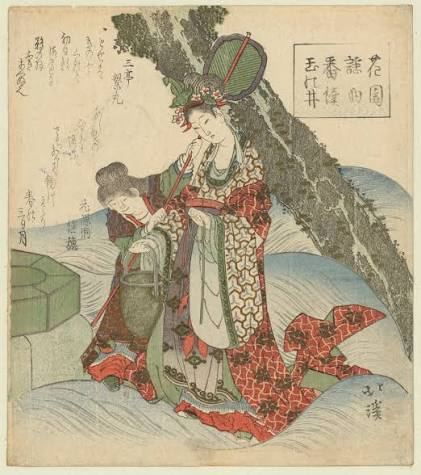
Ukiyo-e depicting the Urashima Taro legend
The imagery of Otohime and the Dragon Palace has also been captured in paintings like this.
The legend
Ryugu Shrine sits at the very tip of Nagasakibana, in Yamakawa, Ibusuki City. Its enshrined deity is Toyotama-hime, the figure corresponding to Otohime, the princess of the Dragon Palace, in the tale of Urashima Taro. Toyotama-hime appears in the Kojiki and Nihon Shoki as the daughter of the sea god, and this area was already layered with local memory as a setting for the "Yamasachihiko and Umisachihiko" myth involving her. It's thought that, on top of this mythological foundation, the fairy tale of Urashima Taro was later superimposed, gradually shaping the legend that "this was the gateway to the Dragon Palace."
The waters off Nagasakibana are remarkably clear and are also known as a nesting ground for sea turtles. This physical reality — a beach where turtles genuinely do come ashore — overlaps with the story's image of riding a turtle to the Dragon Palace, which is likely one reason the legend feels so persuasive. The shrine grounds also carry the custom of writing wishes on seashells and dedicating them, and the shrine is popular as a spot for good fortune in love and relationships.
Not the only claimant to "the birthplace"
In truth, several places across Japan claim to be the "birthplace" of the Urashima Taro legend. Uragashima Shrine in Ine, Kyoto Prefecture; the Shonai Peninsula in Mitoyo, Kagawa Prefecture; Keiun-ji Temple in Yokohama, Kanagawa Prefecture — each has cultivated its own version of the Urashima tale, drawing on locally passed-down legends and on the record of "Mizunoe no Urashimako" found in the Tango Fudoki. The Dragon Palace legend at Nagasakibana takes its place among these many scattered "sites associated with Urashima Taro" across the country.
Next up
Leaving the Satsuma Peninsula's legends behind, we head to Yakushima, off the southern tip of the Osumi Peninsula, to introduce a rarely told controversy over tree rings surrounding "Jomon Sugi," the giant cedar standing in this World Heritage forest.
Read about the Forest of Yakushima →Photos
The imagery of Otohime and the Dragon Palace has also been captured in paintings like this.