Photos
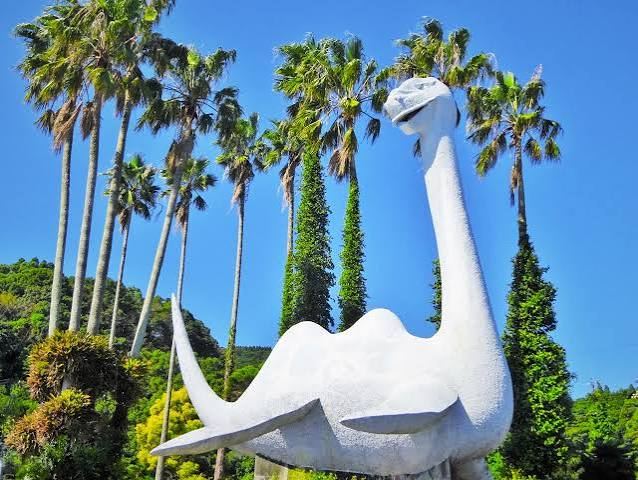
The Issie statue on the lakeshore
An urban legend that has become a symbol of Lake Ikeda.
The first sighting
The best-known Issie sighting dates to September 3, 1978. Around twenty fifth-graders from the nearby Ikezaki district reportedly saw a large black, hump-like shape moving across the water's surface about 300m from shore, in a series of connected humps. The fact that a whole group of children witnessed it at once made it a story too hard to dismiss as a simple misidentification, and it drew widespread attention. This incident is what cemented the nickname "Issie" locally, and sightings at the lake have continued to be reported ever since.
Since then, local residents and visitors have continued to report a black back undulating as it swims, multiple humps breaking the surface, and the water rippling dramatically. In 1991, a TV crew filming the lake reportedly captured mysterious ripples and a moving shadow, which also became a topic of conversation.
Theories about what it is
Several scientific theories have been proposed about Issie's true identity. The most widely favored is the "giant Japanese eel" theory. Lake Ikeda is genuinely home to Japanese giant eels, with individuals confirmed at over 2m in length. The idea is that a large eel swimming in the dark water could, seen from a distance, appear as a series of connected humps.
Other theories point to large carp or grass carp stocked in the lake swimming in schools and being misread as one large creature, or to natural phenomena — distinctive ripple patterns caused by wind or air currents — being mistaken for something alive. At the same time, some reported sightings resist explanation by any of these theories alone, which is part of what keeps the lake's appeal as home to an "unidentified creature" alive.
Issie today
Whatever the truth, Issie has firmly become a symbol of Lake Ikeda and Ibusuki tourism. A giant Issie statue, over 10m long, stands on the lakeshore and is a popular photo spot, and Issie has also become a local mascot character appearing on merchandise and souvenirs. It's a very Kagoshima example of an urban legend transforming into a symbol of regional promotion.
Read about the Boze of Tokara →Photos
An urban legend that has become a symbol of Lake Ikeda.