Photos
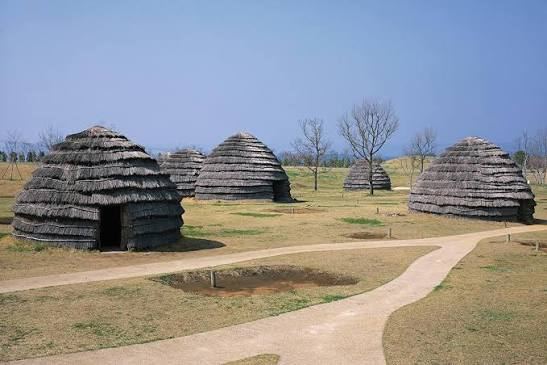
The Kikai Caldera's pre-eruption Jomon settlement
The reconstructed village at the Uenohara site, evidence of southern Kyushu's rich Jomon culture.
Scale
This eruption, which occurred about 7,300 years ago, is known as the Kikai-Akahoya eruption, and is estimated to have released several hundred times the magma volume of Sakurajima's great Taisho eruption of 1914. Recent seafloor surveys have confirmed that the eruption formed a colossal lava dome on the seabed — roughly 10km across and 600m tall, among the largest known anywhere in the world — and in 2024 outlets including National Geographic reported anew on just how large it was.
The eruption column is thought to have reached the stratosphere, and pyroclastic flows crossed the sea to reach Tanegashima, Yakushima, and the southern parts of the Osumi and Satsuma peninsulas. The resulting ash layer (known as Akahoya ash) has been identified not only across Kyushu but as far away as the Kanto region, a testament to just how far-reaching this eruption's effects were.
Impact on Jomon culture
Before the Kikai Caldera eruption, southern Kyushu was home to Jomon-era people who had already built settled communities and a sophisticated pottery culture, as seen at the Uenohara archaeological site (Kirishima City, Kagoshima Prefecture). But in the strata laid down after the eruption, traces of settlements comparable to what came before simply stop appearing. Pyroclastic flows and heavy ashfall are thought to have wiped out the very basis of daily life, dealing what amounts to a devastating blow to Jomon culture in southern Kyushu.
Some research suggests that centuries passed before clear traces of human habitation reappear in southern Kyushu. A single colossal eruption may have reset the region's cultural history altogether — this is another face of Kagoshima's nature, one that lies behind the "spectacular scenery" sold to tourists.
What remains today
Part of the Kikai Caldera's outer rim still rises above the waves today, as the two inhabited islands of Iwo-jima and Take-shima. Iwo-jima remains an active volcanic island, with Mt. Io-dake still emitting smoke; it belongs to Mishima Village and is also said to be the traditional site of "Kikaigashima," the island of exile in the Tale of the Heike associated with the monk Shunkan (more on this on the next page). To grasp the sheer scale of the caldera, it helps to remember that these two islands are just a small fraction of the rim of a collapse structure some 20km across.
Volcanologically speaking, caldera-forming super-eruptions on the scale of the Kikai Caldera (VEI 7 class) are thought to occur roughly once every several thousand to ten thousand years. The odds of the next one happening "tomorrow" are low, but on a geological timescale, it's a phenomenon that could strike at any moment. Next time you're admiring one of southern Kyushu's scenic vistas, it's worth remembering how many of them sit atop the aftermath of past super-eruptions.
Read about Shunkan & Kikaigashima →Photos
The reconstructed village at the Uenohara site, evidence of southern Kyushu's rich Jomon culture.