Photos
The vanishing sand road from above
A land route that only exists at low tide, and sinks beneath the sea at high tide.
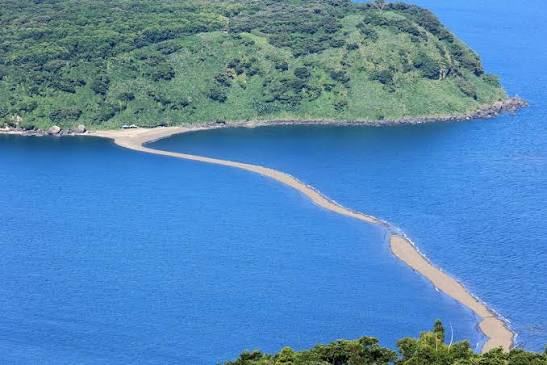
Chiringashima, Ibusuki
Just off the coast of Ibusuki Onsen, at the southern tip of the Satsuma Peninsula, sits Chiringashima, an uninhabited island roughly 3km in circumference. From around March through October, whenever the tide falls during a spring or neap tide, a sand path known as the "Chiringashima Road" surfaces from the sea for roughly 800m, connecting the island to the opposite shore at Tarasaki Cape, and you can walk across. Once the tide comes back in, the path sinks below the sea again, and crossing is no longer possible.
Locals also call this sand path the "Road of Ties That Bind," with a tradition that a wish will come true for anyone who crosses it hand in hand with someone dear to them. Perhaps it's the very instability of a path that appears and disappears with every tide that has made it a symbol of once-in-a-lifetime romance.
Yurigahama, Yoron Island
In the waters north of Yoron Island, the southernmost inhabited island in Kagoshima Prefecture, there's a landform even more ephemeral than an island. Known as Yurigahama, this pure-white sand beach appears only at the lowest of low spring tides, rising above the shallow coral reef — less a "floating island" than a "floating sandbar." Surrounded by emerald-green shallows, the brilliant white sand looks as though it's floating alone in the middle of the sea, which is how it earned its name.
Where and how large it appears changes every time, depending on that day's tides, wind, and wave conditions, so no two views of it are ever quite the same. Local tourist information centers and travel agencies run "Yurigahama landing tours," ferrying visitors by boat during the window when the sandbar is expected to appear based on that day's tide tables, and searching the beach for "star sand" — star-shaped grains made from the shells of foraminifera — is a classic part of the experience.
Next up
The seas around Yoron and Okinoerabu islands aren't just beautiful — they're also home to Kyushu's largest caldera lake, Lake Ikeda, where legends of an unidentified creature are still told today. The next page introduces the legend of "Issie."
Read about Lake Ikeda's "Issie" →Photos
A land route that only exists at low tide, and sinks beneath the sea at high tide.